
Mammogram Singapore: What to Expect, Which Type You Need, and When to Start
✍️ Written by: HOP Medical Centre Health Content Team
📅 Published: June 2026 | 🔄 Last Reviewed: June 2026
Breast cancer is the most common cancer among women in Singapore, accounting for close to 30% of all female cancer cases. Despite this, mammogram screening rates remain lower than they should be. At HOP Medical Centre, the most common reason women give for delaying their first mammogram is not a lack of awareness. Instead, it is uncertainty about what the procedure actually involves, and whether the discomfort they have heard about is exaggerated or real.
A mammogram is a low-dose X-ray of breast tissue. It remains the most effective screening tool for detecting breast cancer early — often well before a lump becomes large enough to feel. Consequently, regular mammography from the appropriate age is one of the most clinically impactful preventive health actions a woman can take.
This guide answers the questions women ask most before booking. What should you expect? Which type of mammogram suits different breast types? When should screening start, and what do the results actually mean?
View Our Breast Cancer Screening PackagesWhy Mammograms Matter for Breast Cancer Detection in Singapore
Breast cancer develops silently in its earliest stages. By the time a lump becomes large enough to feel during self-examination, the cancer has frequently progressed beyond the most treatable stage. Mammography changes this timeline significantly. It can detect tumours years before they become palpable — sometimes when they are still just a few millimetres in size.
Survival outcomes differ substantially by stage at diagnosis. When clinicians detect breast cancer at Stage 1, five-year survival rates exceed 98%. At Stage 4, however, survival rates drop sharply. This gap underscores exactly why mammogram screening matters — not as a precaution, but as a genuinely life-saving clinical tool.
Furthermore, mammography detects more than just lumps. It identifies microcalcifications, tissue density changes, and architectural distortions that often precede a clinically detectable mass by years. As a result, mammography catches abnormalities that neither self-examination nor clinical breast examination can reliably find.
The Singapore Cancer Society identifies breast cancer as the leading cancer among Singaporean women and strongly recommends regular mammography as the primary screening tool for early detection.
When Should You Start Getting Mammograms in Singapore?
📅 Mammogram Screening Timeline by Risk Level
🔹 Average risk, age 40–49: Discuss with your doctor — annual or biennial mammography is reasonable based on personal preference
🔹 Average risk, age 50–69: Most guidelines recommend mammography every one to two years
🔹 Average risk, age 70 and above: Continue screening based on overall health status and life expectancy — discuss with your doctor
🔹 Family history (first-degree relative diagnosed before 50): Consider starting 10 years before the relative’s age at diagnosis, often alongside genetic counselling
🔹 Known BRCA mutation or strong genetic risk: Earlier screening with annual mammography, often combined with MRI, starting in the 30s
For most women with average risk, mammography typically begins between the ages of 40 and 50. The exact starting point depends on clinical guidance and personal preference. From age 50 onwards, screening every one to two years becomes the standard recommendation across most international guidelines.
Women with a family history of breast or ovarian cancer face a different timeline. Specifically, those with a first-degree relative diagnosed before age 50 should discuss earlier screening with their doctor. Many begin ten years before the relative’s age at diagnosis. Additionally, women with a known BRCA1 or BRCA2 mutation typically begin annual screening, sometimes combined with MRI, well before age 40.
The Ministry of Health Singapore supports structured breast cancer screening for women in Singapore as part of national preventive health guidelines, reinforcing the clinical importance of starting mammography at the appropriate age for individual risk level.
Types of Mammograms Available in Singapore
| Type | How It Works | Best For |
|---|---|---|
| 2D Digital Mammogram | Standard digital X-ray imaging of breast tissue from two angles | Routine screening for women with average breast density and average risk |
| 3D Mammogram (Tomosynthesis) | Multiple X-ray images combined to create a 3D reconstruction of breast tissue | Women with dense breast tissue — reduces false positives and improves detection accuracy |
| Breast Ultrasound | Sound waves create real-time images — no radiation involved | Supplementary screening for dense breasts, younger women, or further evaluation of a specific finding |
| Breast MRI | Magnetic imaging providing highly detailed soft tissue contrast | High-risk women (BRCA mutation, strong family history) as a supplement to annual mammography |
For most women, a standard digital mammogram provides sufficient screening accuracy. However, women with dense breast tissue often benefit from 3D mammography or supplementary ultrasound. This category includes a significant proportion of Asian women. Dense tissue can obscure abnormalities on a standard 2D mammogram, making additional imaging clinically valuable rather than optional.
What Happens During a Mammogram Appointment
Understanding what to expect helps reduce the anxiety many women feel before their first mammogram. The actual procedure is brief. For most women, it is also far less uncomfortable than anticipated.
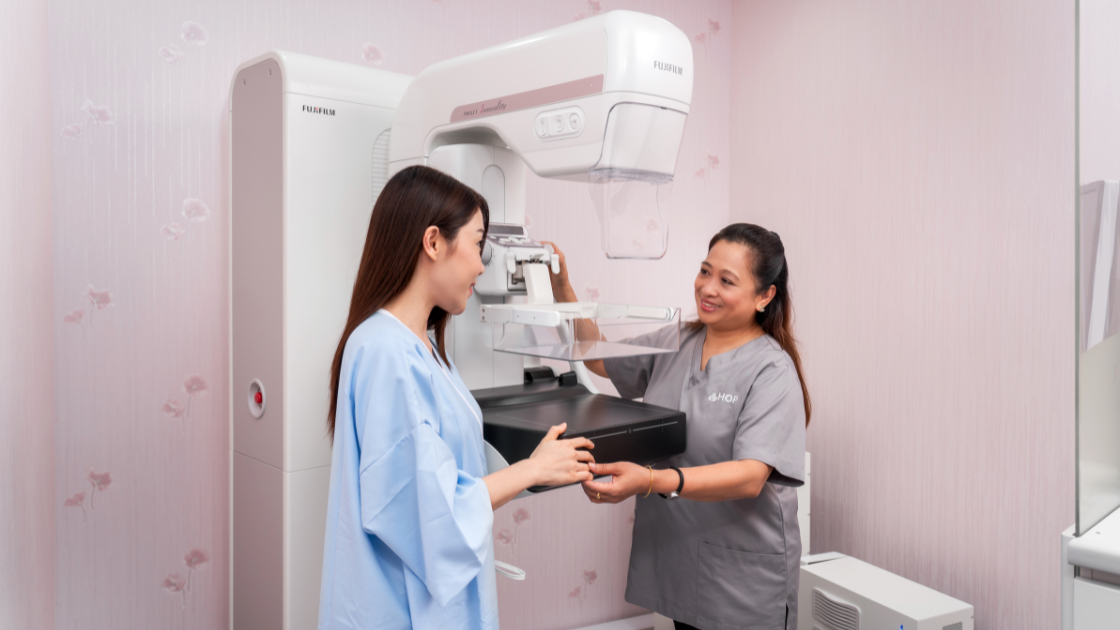
Upon arrival, a radiographer explains the procedure and answers any questions before beginning. The patient changes into a gown, removing clothing and jewellery from the waist up. For each breast, the radiographer positions the tissue on the mammography machine’s plate. A second plate then compresses the breast briefly to spread the tissue for clearer imaging.
Compression typically lasts only a few seconds per image. The radiographer takes two images of each breast — one from above and one at an angle. The entire imaging process generally takes 15 to 20 minutes. Many women describe the compression as uncomfortable rather than painful, and the sensation passes quickly once each image is captured.
Managing Discomfort and Anxiety Before Your Mammogram
Several practical steps reduce discomfort during the appointment. Scheduling the mammogram one to two weeks after your period often makes a meaningful difference, since breasts are typically less tender during this window. Limiting caffeine intake in the days beforehand may also reduce breast sensitivity for some women.
Wearing a two-piece outfit makes undressing more straightforward, since only the top half needs removing. Additionally, informing the radiographer about any specific concerns, prior breast surgery, or implants beforehand ensures the imaging process accounts for individual anatomy appropriately.
For women who feel anxious about the procedure, HOP Medical Centre’s clinical team takes time to explain each step clearly. The team also paces the appointment according to individual comfort. This approach, in our experience, significantly reduces first-time mammogram anxiety for most patients.
Understanding Your Mammogram Results
Mammogram results typically use the BI-RADS (Breast Imaging Reporting and Data System) classification. This standardised scale helps radiologists communicate findings clearly and consistently.
A normal mammogram or benign finding receives a BI-RADS 1 or 2 score, requiring no further action beyond routine screening. When the images are inconclusive, the result is BI-RADS 0, and additional imaging becomes necessary — this is common and does not necessarily indicate a problem. A probably benign finding, by contrast, receives a BI-RADS 3 score, typically followed by a short-interval repeat scan in six months to confirm stability.
What a BI-RADS 4 or 5 Result Means
Findings that require further investigation receive a BI-RADS 4 or 5 score. This usually leads to additional imaging and, in many cases, a biopsy to determine whether the finding is cancerous. Receiving this result is, understandably, frightening. It is important to know, however, that many biopsies following a BI-RADS 4 or 5 result return benign findings. The classification simply reflects the need for further investigation — not a cancer diagnosis.
HOP Medical Centre’s clinical team explains BI-RADS results clearly at every appointment and supports patients through any necessary follow-up with prompt referral and clear guidance.
Mammograms for Women With Dense Breast Tissue
Breast density is a factor many women only learn about from their first mammogram report. Dense breast tissue contains proportionally more glandular and connective tissue relative to fat. This density appears white on a mammogram — the same colour as many abnormalities. Consequently, dense tissue can mask small tumours on standard imaging.
Approximately 40% of women have dense breast tissue, and density tends to be higher in Asian women compared to some other populations. For these women, supplementary screening with ultrasound or 3D mammography meaningfully improves detection accuracy.
If your mammogram report mentions dense breast tissue, discuss with your doctor whether supplementary imaging would benefit your specific program. HOP Medical Centre’s breast cancer screening service offers both digital mammography and ultrasound, allowing the clinical team to tailor the imaging approach to each woman’s breast composition.
Integrating Mammograms Into Your Health Screening Program
Mammography is most effective when part of a structured, recurring screening program rather than a one-time or irregular event. Women benefit from combining breast screening with cervical cancer screening and core metabolic and cardiovascular markers within one coordinated annual appointment.
HOP Medical Centre’s Women’s Health Screening Package integrates mammography alongside cervical screening, hormonal assessment, and general health markers. This removes the need for multiple separate bookings across different providers. For women specifically focused on cancer prevention, the Cancer Screening Package structures mammography and other cancer markers around individual age and risk profile.
The Health Promotion Board Singapore supports regular mammography for women in Singapore as a national health priority under the Healthier SG initiative, reinforcing why consistent, scheduled screening delivers far more value than occasional, ad-hoc check-ups.
Book Your Mammogram at HOP Medical CentreFrequently Asked Questions: Mammogram Singapore
When should I get my first mammogram in Singapore? Most women with average risk should start mammography between ages 40 and 50, depending on clinical guidance and personal preference. From age 50 onwards, screening every one to two years becomes the standard recommendation. Women with a family history of breast or ovarian cancer, particularly a first-degree relative diagnosed before age 50, should discuss earlier screening with their doctor.
Is a mammogram painful? Most women describe the brief compression involved in a mammogram as uncomfortable rather than painful. Each compression lasts only a few seconds, and the entire appointment typically takes 15 to 20 minutes. Scheduling your mammogram one to two weeks after your period, when breasts are less tender, can reduce discomfort further.
What is the difference between a mammogram and a breast ultrasound? A mammogram uses low-dose X-rays to image breast tissue and is the primary screening tool for most women. A breast ultrasound uses sound waves and involves no radiation, making it useful as a supplementary tool for women with dense breast tissue. Many women benefit from both, used together rather than as alternatives to each other.
What does a BI-RADS score mean on my mammogram report? BI-RADS is a standardised scale radiologists use to classify mammogram findings. A score of 1 or 2 indicates normal or benign findings. A score of 0 means additional imaging is needed for a clearer picture. A score of 3 suggests a probably benign finding requiring a short-interval follow-up scan. Scores of 4 or 5, meanwhile, indicate findings that need further investigation, typically including a biopsy.
Do I need a mammogram if I have dense breast tissue? Yes — mammography remains important even with dense breast tissue. However, dense tissue can mask small abnormalities on standard imaging. Consequently, many women with this finding benefit from supplementary screening with ultrasound or 3D mammography. Discuss your specific breast density with your doctor to determine whether additional imaging would strengthen your program.
More Questions About Mammograms in Singapore
How much does a mammogram cost in Singapore? Mammogram costs in Singapore vary by provider and whether the test is part of a broader screening package. As a standalone test, mammograms typically range from SGD 100 to SGD 250. When included within a comprehensive Women’s Health Screening Package, the combined pricing often delivers better overall value. Contact HOP Medical Centre directly for current pricing.
Can I get a mammogram if I have breast implants? Yes. Women with breast implants can still undergo mammography. The procedure, however, requires additional imaging angles and a radiographer experienced in working with implants. Inform the clinic when booking so the team can allocate appropriate time and expertise for your appointment.
How long does it take to get mammogram results in Singapore? At HOP Medical Centre, mammogram results are typically available within a few working days after the radiologist completes their review. If a finding requires urgent follow-up, the clinical team contacts the patient promptly rather than waiting for the standard reporting timeline.
Is mammogram screening covered by MediSave or insurance in Singapore? Some insurance plans and corporate health benefits cover mammogram screening, particularly when a doctor refers the patient or when it forms part of an Integrated Shield Plan’s preventive care coverage. Mammography is also available through Singapore’s Screen for Life program at subsidised rates for eligible women. Contact HOP Medical Centre to confirm current package pricing and insurance documentation support.
Early Detection Starts With Showing Up for the Mammogram
Breast cancer’s position as Singapore’s most common cancer among women makes mammography one of the most consequential preventive health decisions a woman can make. The procedure itself is brief. The discomfort, for most women, is genuinely manageable. The clinical value, by contrast, is substantial — often making the difference between a Stage 1 diagnosis and a far more advanced one.
At HOP Medical Centre, our clinical team approaches mammography with the reassurance, clarity, and clinical thoroughness that this screening deserves. Whether you are booking your first mammogram or maintaining a consistent annual program, our team at Orchard (Palais Renaissance) and Tampines (CPF Building) makes the process as comfortable and straightforward as possible.
Explore HOP Medical Centre’s breast cancer screening packages and book your mammogram today.