
Female Health Screening Singapore: What to Test, When to Start, and Why It Matters
✍️ Written by: HOP Medical Centre Health Content Team
📅 Published: August 2026 | 🔄 Last Reviewed: Sept 2026
Female health screening in Singapore requires a clinical approach that evolves meaningfully across each decade of a woman’s life. At HOP Medical Centre, we see this evolution clearly in clinical practice. The health priorities of a 28-year-old are genuinely different from those of a 42-year-old in perimenopause. Both differ significantly from the clinical needs of a 58-year-old post-menopausal woman managing cardiovascular risk and bone health. Consequently, a single generic annual check applied uniformly across all women produces incomplete clinical coverage at every stage.
Women face a distinct and well-documented health profile. Breast cancer is the most common cancer in Singaporean women. Cervical cancer is preventable with consistent screening. Furthermore, the hormonal changes of perimenopause and menopause reshape cardiovascular, metabolic, and bone health in ways that standard metabolic panels do not detect. Autoimmune conditions — including thyroid disorders and lupus — affect women at significantly higher rates than men. This makes hormonal and immune markers a clinical priority in female health screening that has no direct equivalent in male programs.
This guide covers what female health screening in Singapore should include at each life stage, which conditions are most clinically significant for women, how hormonal changes affect the screening picture, and how HOP Medical Centre structures women’s health programs from the 20s through to post-menopause.
View Our Women’s Health Screening PackagesWhy Female Health Screening Singapore Requires Its Own Clinical Framework
Female health screening is not a general health screening program with a mammogram added at the end. The conditions that carry the greatest clinical risk for women — and the tests that detect them earliest — differ meaningfully from those most relevant for men. This difference warrants a genuinely distinct clinical approach across every decade of adult life.
The cancer landscape for women differs significantly from men. Breast cancer accounts for nearly 30% of all female cancer cases — requiring dedicated mammography and, for dense breast tissue, supplementary ultrasound. Cervical cancer is almost entirely preventable through consistent Pap smear or HPV DNA testing. Additionally, ovarian cancer carries the highest mortality rate among gynaecological cancers and warrants CA-125 surveillance for women with relevant family history.
How Hormonal Architecture Shapes Female Clinical Needs
The hormonal architecture of women’s health creates clinical complexity that does not exist in the same way for men. Oestrogen influences cardiovascular health, bone density, lipid profile, cognitive function, and body composition simultaneously. As oestrogen declines through perimenopause and menopause, each of these systems shifts. Standard metabolic monitoring alone cannot adequately track these changes.
Thyroid disorders affect women at approximately five to eight times the rate of men. Iron deficiency — particularly in women with heavy periods — causes significant fatigue and hair loss. This is frequently attributed to stress or menopause without testing the simplest available clinical explanation. Furthermore, autoimmune conditions including rheumatoid arthritis, lupus, and Hashimoto’s thyroiditis are all significantly more prevalent in women than men.
The Ministry of Health Singapore identifies breast cancer, cervical cancer, and metabolic disease as the three primary women’s health priorities in its national preventive health framework — reinforcing why female health screening programs should address these conditions specifically rather than relying on generic adult panels.
Female Health Screening Singapore: What to Test at Each Life Stage
The right screening program changes significantly across each decade. The table below outlines what each life stage warrants clinically — from the reproductive years through to post-menopause.
| Age Group | Core Screening Components | Women-Specific Additions |
|---|---|---|
| 20s | Blood pressure, BMI, fasting glucose, full lipid profile, full blood count, liver function, kidney function, thyroid function, urine analysis | Cervical screening from age 25; iron and ferritin; STD screening where sexually active; HPV vaccination if not previously received |
| 30s | All above plus HbA1c; cardiovascular risk assessment | Continued cervical screening; iron and ferritin; annual thyroid function; hormonal assessment where cycle irregularity, PCOS, or fertility concerns exist |
| 40s | Full executive panel — ECG, chest X-ray, abdominal ultrasound, cancer markers, physician consultation | Mammography from age 40; cervical screening; perimenopausal hormonal panel; bone density baseline; Vitamin D; CA-125 with family history |
| 50s | Full executive panel annually; colorectal screening; cardiac stress test where indicated | Annual mammography; cervical screening; bone density monitoring; postmenopausal hormonal assessment; expanded cardiovascular markers; CA-125 surveillance |
| 60s and beyond | Full executive panel; intensified cancer surveillance; cardiovascular monitoring | Annual mammography; bone density every two years; cardiovascular risk management; kidney function monitoring; medication review alongside screening |
Breast Cancer Screening: The Most Important Annual Commitment for Women
Breast cancer is the most common cancer in Singaporean women — responsible for nearly 30% of all female cancer diagnoses. The five-year survival rate at Stage 1 exceeds 98%. At Stage 4, that figure drops sharply. Consequently, beginning annual mammography at 40 rather than deferring until symptoms appear is one of the most important health decisions a woman makes in this decade.
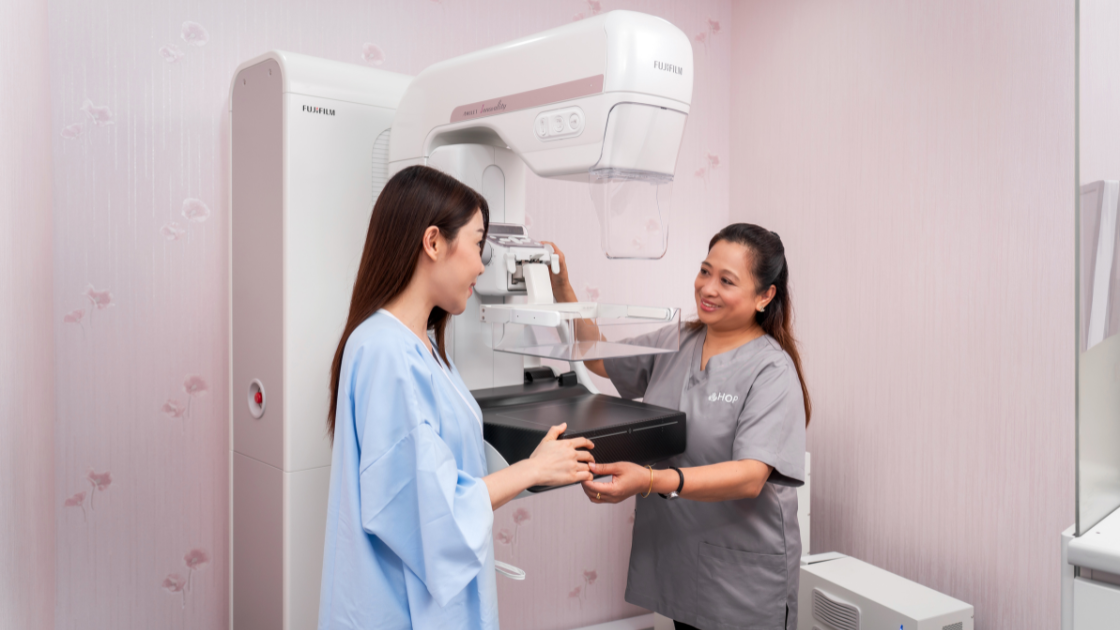
Mammography detects tumours at sizes far smaller than clinical or self-examination can feel. Annual mammography from age 40 provides detection at the stage where treatment is least invasive and most likely to succeed. HOP Medical Centre’s breast cancer screening service offers digital mammography and breast ultrasound. The clinical team guides each patient on which approach suits her breast composition and risk profile.
Women with dense breast tissue — a category that includes a significant proportion of Asian women — benefit from supplementary ultrasound alongside mammography. Dense tissue can obscure small tumours on standard imaging. Furthermore, women with a first-degree relative diagnosed with breast cancer before age 50 should begin mammography earlier and discuss MRI surveillance with their doctor.
Cervical Cancer Screening: Preventable With Consistent Testing
Cervical cancer is one of the most preventable cancers in existence. Over 99% of cases develop from persistent HPV infection. Pap smear and HPV DNA testing reliably detect this at the precancerous stage — years before cancer develops.
Women aged 25 to 69 who have ever been sexually active should screen every three years with a Pap smear or every five years with HPV DNA testing. HOP Medical Centre’s cervical cancer screening service offers both options. HPV vaccination provides additional protection alongside cervical screening — neither replaces the other. HOP Medical Centre’s HPV vaccination service is additionally available for women who have not previously received the vaccine.
Perimenopause and Menopause: The Hormonal Shift That Changes Everything
The perimenopausal and menopausal transition typically begins in the early to mid-40s. It produces hormonal changes that affect virtually every aspect of a woman’s health simultaneously. Cycle irregularity, sleep disruption, mood changes, hot flushes, brain fog, joint pain, weight gain, and hair thinning each individually have multiple explanations. Together, they suggest perimenopausal hormonal change. Blood tests, however, are the only reliable way to distinguish this from thyroid disorder or iron deficiency.
A perimenopausal hormonal panel — covering FSH, LH, oestradiol, and AMH — helps the clinical team understand where a woman sits in the menopausal transition. This context changes how symptoms are interpreted and which management strategies are most appropriate. Additionally, AMH provides an indication of remaining ovarian reserve for women in their early 40s who want to understand their reproductive timeline.
Thyroid function testing warrants particular emphasis at this life stage. Hypothyroidism produces fatigue, weight gain, mood changes, and cycle irregularities that mirror perimenopausal symptoms almost exactly. Without a TSH blood test, thyroid disorder and perimenopause are clinically indistinguishable. Consequently, HOP Medical Centre includes thyroid function as a standard component of health screening for women from their 40s onwards.
Cardiovascular Risk in Women: The Decade-Specific Rising Threat
⚠️ Cardiovascular Risk in Women: What Most Women Don’t Know
🔹 Heart disease is the leading cause of death in women globally — yet it is widely perceived as a male condition, leading to systematic under-screening and later diagnosis in women
🔹 Women’s cardiac symptoms differ from men’s — breathlessness, fatigue, nausea, and back or jaw pain are more common presentations than the classic chest pain most people recognise
🔹 Oestrogen protection disappears after menopause — women’s cardiovascular risk rises sharply in the years following menopause, often catching both patients and clinicians off-guard
🔹 Conditions specific to women carry long-term cardiovascular implications — gestational hypertension, pre-eclampsia, and PCOS all associate with elevated cardiovascular risk decades after the original condition
🔹 The protective effect of oestrogen masks underlying risk — women who develop hypertension or dyslipidaemia in their 30s carry higher cardiovascular risk than equivalent numbers suggest
Cardiovascular disease is the leading cause of death among women globally — yet it is persistently perceived as a male condition. This perception gap produces real clinical consequences. Women are less likely to receive proactive cardiac screening. Their symptoms are more frequently attributed to anxiety or stress. As a result, cardiovascular disease in women often presents at a more advanced stage than in men.
The 40s represent the decade where women’s cardiovascular risk begins rising meaningfully as oestrogen protection fades. LDL typically rises. HDL falls. Blood pressure increases. Additionally, arterial stiffness develops. A comprehensive cardiovascular assessment covers full lipid panel, blood pressure, fasting glucose, HbA1c, and where clinically indicated, ECG. Together, these markers allow the clinical team to calculate overall cardiovascular risk and identify which interventions are warranted before a clinical event occurs.
HOP Medical Centre’s Executive Health Screening program provides this comprehensive cardiovascular baseline — interpreted alongside hormonal, metabolic, and cancer markers to give a complete health picture.
Bone Health: Why the Perimenopausal Window Matters Most
Osteoporosis develops silently. Its first clinical sign is frequently a fracture of the hip, spine, or wrist that earlier detection could have prevented. The perimenopausal years see the fastest rate of bone density decline in a woman’s lifetime. A baseline DEXA scan in the early 40s provides a clinical reference point for tracking future bone loss. Consequently, discovering significant osteoporosis only after a fracture has already occurred is a preventable clinical outcome.
Vitamin D deficiency is extremely common in women working indoor office hours. Despite Singapore’s tropical climate, many women receive minimal sun exposure during working hours. Low Vitamin D accelerates bone loss independently. Testing and correcting Vitamin D deficiency is therefore a critical companion to bone density monitoring.
Women with specific risk factors — long-term steroid use, low body weight, prior fractures, strong family history of osteoporosis, or early menopause — benefit from earlier DEXA assessment rather than waiting until the standard screening age.
Iron, Thyroid, and Vitamin D: Three Commonly Missed Markers
Three markers appear consistently in assessments of women presenting with fatigue, hair loss, weight changes, and low mood. All three are commonly absent from basic annual health checks.
Iron and ferritin — haemoglobin testing alone misses iron deficiency in a meaningful proportion of women. Ferritin falls to growth-impairing levels before haemoglobin drops into the anaemic range. Women with heavy perimenopausal periods are particularly vulnerable. HOP Medical Centre’s screening panel includes both haemoglobin and ferritin as standard — not haemoglobin alone.
Thyroid function (TSH) — thyroid disorders affect women at five to eight times the rate of men. Prevalence rises significantly in the 40s and 50s. Both hypothyroidism and hyperthyroidism produce symptom clusters that overlap closely with perimenopause, iron deficiency, and depression. A TSH blood test is therefore essential context for any assessment of women’s health symptoms rather than an optional addition.
Vitamin D and Why It Matters in Female Health Screening
Vitamin D deficiency carries clinical significance for bone health and immune function. Correction through supplementation is straightforward once a deficiency is confirmed. Nevertheless, it remains absent from most basic annual health checks across Singapore. HOP Medical Centre includes Vitamin D as a standard component of female health screening from age 40 onwards — not as an optional addition. In this way, the program addresses a commonly missed driver of fatigue, bone loss, and immune dysfunction in one additional blood draw.
Gynaecological Cancer Surveillance Beyond Cervical Screening
Cervical cancer screening covers only one of three significant gynaecological cancers. Ovarian cancer and uterine cancer each require additional clinical attention — particularly for women with specific risk factors.
Ovarian cancer carries the highest mortality rate among gynaecological cancers — primarily because it produces no symptoms until late stage. CA-125 blood testing alongside pelvic ultrasound provides surveillance for women with a family history of ovarian or breast cancer or those with BRCA mutations. HOP Medical Centre’s cancer screening program includes CA-125 as part of the age and risk-appropriate cancer marker panel for women.
Uterine cancer — the most common gynaecological cancer in Singapore — produces early symptoms in most cases, including abnormal uterine bleeding. Prompt clinical assessment of any abnormal bleeding is the most appropriate clinical approach. The clinical team at HOP Medical Centre guides women on when symptoms warrant urgent assessment.
Colorectal cancer affects women at a similar frequency to men. Annual FIT testing from age 50, or colonoscopy every ten years, provides the same preventive benefit. Women with a family history of colorectal cancer should begin screening ten years before the relative’s diagnosis age. Consequently, colorectal surveillance belongs in every comprehensive female health screening program from age 50 onwards.
HOP Medical Centre’s Female Health Screening Singapore Package
HOP Medical Centre’s Women’s Health Screening Package brings the complete clinical picture together in a single coordinated appointment — structured around the specific health priorities women face at each life stage rather than a generic adult health panel.
The program covers blood pressure and BMI, full blood count, full lipid profile, fasting glucose and HbA1c, kidney function, liver function, thyroid function, iron and ferritin, and Vitamin D. It additionally covers ECG, chest X-ray, abdominal and pelvic ultrasound, age-appropriate cancer markers including CA-125 and CEA where indicated, mammography or breast ultrasound, cervical screening, hormonal panel where clinically relevant, bone density assessment where indicated, and physician consultation with personalised result interpretation.
Why One-Stop Female Health Screening Produces Better Outcomes
All program components complete within the same clinic at both Orchard (Palais Renaissance) and Tampines (CPF Building). There is therefore no need to coordinate separate imaging appointments at a different facility. Furthermore, the physician consultation interprets all findings together rather than as isolated data points — ensuring each patient leaves with a clear clinical picture and specific next steps rather than a printed report to navigate independently.
The Health Promotion Board Singapore supports women’s health as a distinct preventive care priority — with specific national programs addressing breast cancer, cervical cancer, and metabolic health screening for Singapore’s adult female population.
Book Your Women’s Health Screening at HOP Medical CentreFrequently Asked Questions: Female Health Screening Singapore
What does female health screening in Singapore include?
A comprehensive female health screening program at HOP Medical Centre covers blood pressure and BMI, full blood count, full lipid profile, fasting glucose and HbA1c, kidney function, liver function, thyroid function, iron and ferritin, Vitamin D, ECG, chest X-ray, abdominal and pelvic ultrasound, age-appropriate cancer markers, mammography or breast ultrasound, cervical screening, hormonal panel where clinically relevant, and physician consultation. The program therefore addresses cardiovascular risk, metabolic health, hormonal assessment, bone health, and cancer surveillance within one coordinated appointment.
At what age should women start health screening in Singapore?
Cervical screening begins at age 25 for women who have ever been sexually active. Breast cancer screening through mammography begins at age 40 for average-risk women — earlier for those with family history or known BRCA mutations. Comprehensive executive-level health screening suits most women from age 40 onwards. Additionally, women under 40 with risk factors — family history, elevated BMI, irregular cycles, or PCOS — benefit from earlier engagement with broader testing.
When should women start mammograms in Singapore?
Women with average breast cancer risk should start mammography from age 40. Women with a first-degree relative diagnosed with breast cancer before age 50, or those with a known BRCA1 or BRCA2 mutation, should discuss earlier and more frequent screening with their doctor. HOP Medical Centre offers digital mammography and breast ultrasound for women at different risk levels — with clinical guidance on which approach suits each patient’s breast tissue composition.
Does female health screening include hormonal testing?
Hormonal assessment forms part of HOP Medical Centre’s female health screening program where clinically relevant — particularly for women in their 40s experiencing perimenopausal symptoms, those with irregular cycles or PCOS, and those in their 30s with fertility concerns. A hormonal panel covering FSH, LH, oestradiol, AMH, and testosterone where indicated produces a complete picture of hormonal status. Thyroid function testing is standard across all age groups in HOP Medical Centre’s women’s health program.
Is bone density testing part of female health screening in Singapore?
Bone density assessment through DEXA scan forms part of HOP Medical Centre’s female health screening program from the early 40s for women with specific risk factors. For women without specific risk factors, a baseline DEXA in the early to mid-40s provides a useful reference point for tracking future bone loss. Vitamin D testing accompanies bone density monitoring as a standard component — not an optional addition.
More Questions About Female Health Screening in Singapore
How is female health screening different from a standard annual check?
A standard annual check covers blood pressure, total cholesterol, fasting glucose, and urine analysis. Female health screening adds full lipid profiling, organ function in depth, thyroid assessment, iron and ferritin, Vitamin D, ECG, chest X-ray, abdominal and pelvic ultrasound, mammography, cervical screening, hormonal assessment, age-appropriate cancer markers, and physician-guided result interpretation. The women-specific additions reflect the distinct clinical risk profile that adult women carry — particularly around breast cancer, cervical health, thyroid disorders, iron deficiency, and hormonal change.
Can I book women’s health screening without a referral at HOP Medical Centre?
Yes. HOP Medical Centre accepts direct bookings for women’s health screening without a referral from a GP or specialist. Both Orchard (Palais Renaissance) and Tampines (CPF Building) clinic locations are available. Same-week appointments are typically accessible. Furthermore, all consultations take place in private rooms with full confidentiality — results and clinical details are never shared without explicit written consent.
Does women’s health screening include STD testing?
STD testing is a separate clinical service from the general women’s health screening program — but both are available at HOP Medical Centre. Women who want to include STD screening alongside their annual health check can book both in the same visit. The clinical team conducts each assessment confidentially — covering HIV, hepatitis B, hepatitis C, syphilis, chlamydia, and gonorrhoea alongside the standard women’s health markers.
How long does a women’s health screening appointment take at HOP Medical Centre?
Most women’s health screening appointments at HOP Medical Centre complete in 60 to 90 minutes — covering all blood collection, imaging, ECG, mammography or breast ultrasound, cervical screening where included, and physician review in a single in-house visit. Programs that include additional components such as bone density assessment may take slightly longer. Fasting for eight to ten hours before the appointment ensures the most accurate metabolic and lipid results.
Screen Consistently. Know Your Body. Protect Your Next Decade.
Female health screening in Singapore works best when it evolves with each decade of life — not when it applies the same basic annual panel from 25 to 65 regardless of changing clinical priorities. The conditions most clinically significant for Singaporean women — breast cancer, cervical cancer, thyroid disorders, iron deficiency, cardiovascular disease, and bone health — all respond significantly better to early detection than to symptomatic presentation.
At HOP Medical Centre, female health screening is a genuinely comprehensive clinical program. It addresses cancer surveillance, hormonal health, cardiovascular risk, metabolic markers, bone health, and reproductive health within a single coordinated appointment. Physician-guided result interpretation ensures findings are understood and acted on — not filed away unread.
With clinic locations at Orchard (Palais Renaissance) and Tampines (CPF Building), direct booking without referral, and full confidentiality at every step, HOP Medical Centre makes comprehensive annual female health screening practically achievable for Singapore’s working women.
Book your women’s health screening at HOP Medical Centre and build the annual clinical program that reflects your actual health priorities — at every age.